

Bladder cancer is common, expensive to monitor, and often diagnosed through invasive procedures. The American Cancer Society estimates about 84,530 new cases and 17,870 deaths from bladder cancer in the United States in 2026. Globally, an estimated 614,298 new cases and 220,596 deaths occurred in 2022. The disease is more common in men, and smoking is the biggest risk factor.
The outlook is better when the disease is caught early. Reported five-year survival is 79%, largely because about half of cases are diagnosed before the cancer has spread. Most patients present with non-muscle-invasive bladder cancer (NMIBC), which accounts for about 75% of bladder cancer cases. Many of these tumors recur, so patients need years of repeat monitoring.
Detection and surveillance still rest on two pillars: cystoscopy, in which a camera is passed through the urethra into the bladder, and urine cytology, in which a pathologist examines urine for abnormal cells. Both have drawbacks.
- Cystoscopy is invasive and uncomfortable. Patients with superficial disease tend to have recurrent but not progressive disease, necessitating life-long surveillance.
- Urine cytology is highly specific but misses many tumors. Its reported sensitivity for low-grade disease varies widely, between 3% and 67%, compared with 37–95% for high-grade disease. Another review noted that cytology is limited in detecting low-grade tumors, which make up the majority of new diagnoses.
- Commercial urine marker tests have mostly failed to replace cystoscopy. One review concluded that although several urinary markers show higher sensitivity than cytology, they remain insufficient to replace cystoscopy, and most have lower specificity.
A non-invasive urine test that reliably detects bladder cancer, including low-grade disease, would be a major advance. A new study in Nature Medicine suggests one may be emerging, and it is built on RNA rather than DNA.
Join Weekly Health Newsletter
Every week, I will share with you information about Natural Health, Diet, Exercise, Yoga & Wellness.
URINE CELL-FREE RNA [cfRNA]
What is cfRNA?
Cells release fragments of nucleic acids into body fluids, including blood and urine. The best-known are cell-free DNA (cfDNA) and circulating tumor DNA (ctDNA), which underpin most liquid biopsy tests. Cell-free RNA (cfRNA) is the RNA counterpart: short, fragmented transcripts shed by living and dying cells.
DNA tells you which mutations a cell carries. RNA tells you which genes the cell is actively using. That makes cfRNA a window into tumor biology, including cell type, grade, immune activity and proliferation, that DNA mutations alone cannot show.
Why Urine?
Urine contacts bladder tumors directly, can be collected painlessly, and can be sampled repeatedly. Urine cfRNA has been little explored. As the authors put it, earlier work mostly examined only a handful of genes.
The new study found that urine cfRNA is highly fragmented and comes mainly from epithelial cells. Urinary sediment RNA, in contrast, is mostly from white blood cells. Urine cfRNA from healthy people primarily carries transcripts from the bladder, kidney and prostate. Prostate transcripts appeared in males but not females, which supports the specificity of the approach. These genitourinary transcripts were largely absent from plasma cfRNA in healthy controls.
THE RESEARCH
A Stanford-led team (first author Kevin J. Liu, with senior authors Ash Alizadeh, Joseph Liao and Maximilian Diehn) published the paper in Nature Medicine on 2 October 2026. Their goal was to build a sequencing method for urine cfRNA and test whether it can detect bladder cancer, characterize tumors, and guide treatment.
The Method: uRARE-seq
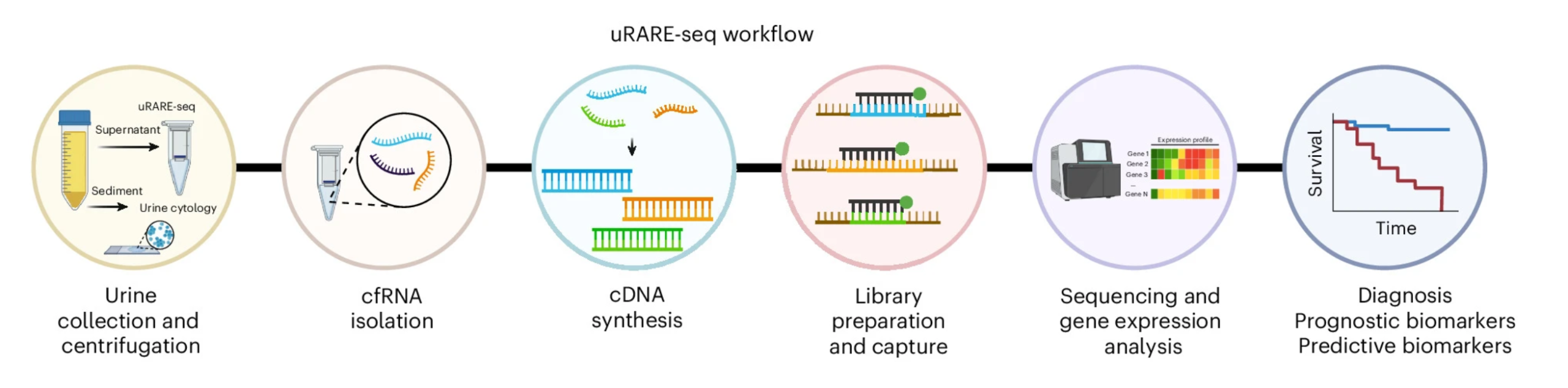
The method, uRARE-seq (urine random priming and affinity capture of cfRNA fragments for enrichment analysis by sequencing), adapts RARE-seq, an approach the same group developed for plasma cfRNA. In that earlier work, published in Nature in 2025, RARE-seq was about 50-fold more sensitive for detecting tumor-derived cfRNA than whole-transcriptome RNA-seq, with a limit of detection of 0.05%.
The team optimized uRARE-seq for urine. They compared RNA extraction methods, tested preservatives, and checked stability. cfRNA concentration and gene expression stayed stable for up to 48 hours after collection and after a freeze–thaw cycle.
The researchers also built a custom capture panel of 3,834 "urine rare abundance genes" (uRAGs). These are genes rarely expressed in healthy urine, so any signal from them stands out. Adding housekeeping genes, cancer-associated genes and immune markers brought the panel to 4,782 genes. Compared with whole-transcriptome capture, the panel achieved higher unique sequencing depth and detected more genes in control samples.
In total, the study analyzed 683 urine samples from 515 individuals, including patients with bladder, kidney and prostate cancer and controls.
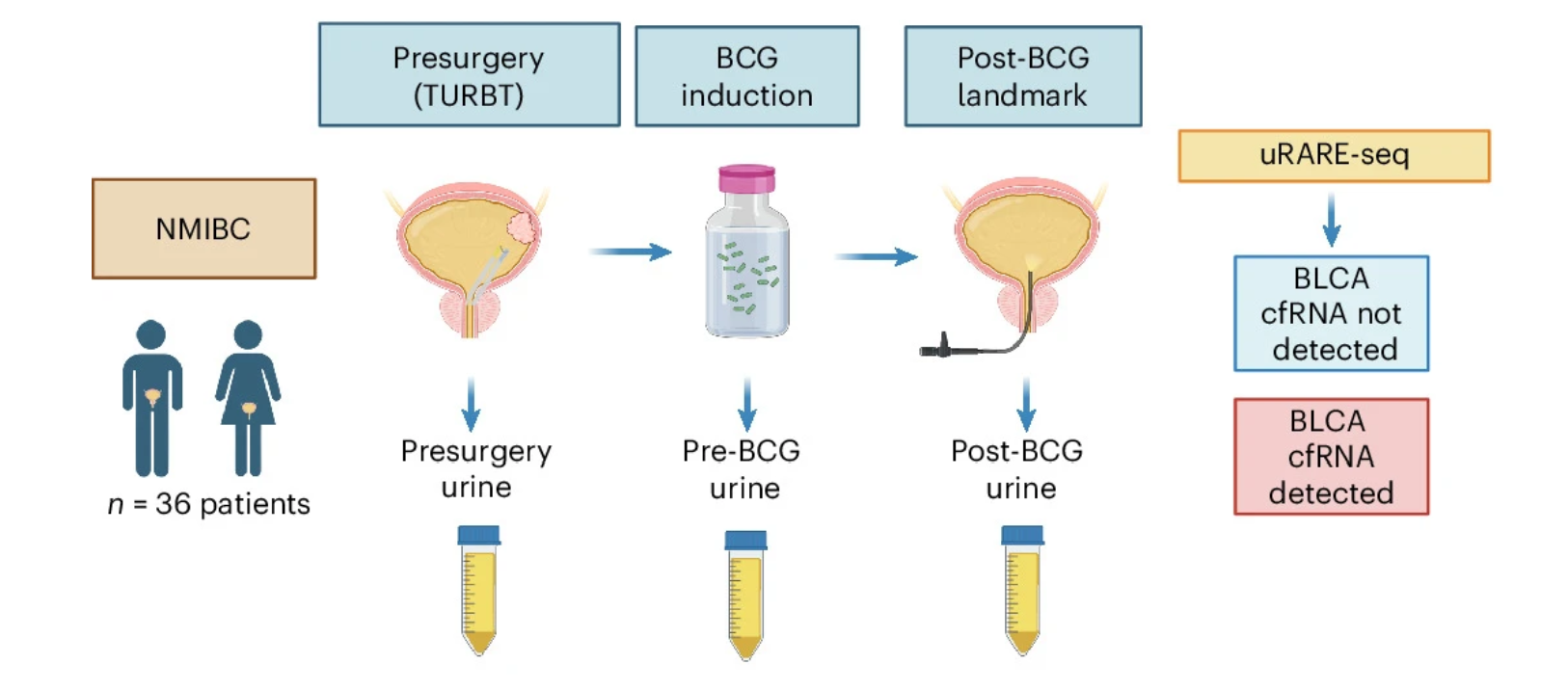
Schematic of BLCA urine collections in a cohort of 36 patients with NMIBC undergoing surgery (transurethral resection of bladder tumor) plus BCG treatment.
Finding 1: Urine cfRNA reflects genitourinary tumors
Urine cfRNA profiles from patients with bladder, kidney (renal cell) and prostate cancer were transcriptionally distinct. Each showed genes you would expect:
- Bladder cancer: IGF2, CRH, ANXA10, KRT5, KRT14
- Kidney cancer: solute carrier genes, NAT8, ACSM2A/2B
- Prostate cancer: AR, KLK2, KLK3 (PSA), FOLH1 (PSMA), TGM4
In matched samples, tumor tissue RNA and urine cfRNA correlated strongly (R = 0.91).
Finding 2: High sensitivity for detecting bladder cancer
The team trained a "BLCA detection model" with elastic net machine learning, a regularized form of logistic regression. It uses 381 genes and was trained on 100 controls and 151 bladder cancer samples. Controls included both asymptomatic people and people with hematuria or urinary symptoms.
Key results:
- AUC of 0.97, with 95% sensitivity at 90% specificity in the training cohort.
- Sensitivity was high across stages and grades: 86% for low-grade Ta tumors, 95% for high-grade Ta, and 100% for carcinoma in situ, high-grade T1 and high-grade T2.
- In an independent validation cohort (142 bladder cancer samples, 140 controls) using the locked model, performance was nearly identical: 94% sensitivity and about 12% false-positive rate.
- The analytical limit of detection was about 0.05% tumor-derived fraction in in silico spiking experiments.
- Specificity stayed high in people with benign urologic conditions.
Finding 3: Better than cytology and tumor-naive urine DNA
In 93 paired samples, uRARE-seq detected 89 cases (95.7%) versus 32 (34.4%) for urine cytology. Cytology caught no low-grade Ta tumors, while uRARE-seq detected 90% (28 of 31).
The comparison with urine tumor DNA is also informative. The model had higher sensitivity than a tumor-naive urine DNA assay (99% versus 85%, P < 0.001). It matched a tumor-informed, field-effect-aware DNA assay (96% for both), which needs sequencing of the patient's own tumor first. uRARE-seq needs no such step and classifies a single sample.
The study also reports that cfRNA detection was not affected by "field-effect" mutations. These are mutations in normal-appearing urothelium that can produce false positives in DNA-based tests. The authors suggest this is because the expression programs of such cells resemble normal urothelium more than cancer.
Finding 4: Grade and muscle invasion
Two further models used the same urine data:
- A grade model distinguished high-grade from low-grade disease (AUC 0.84 in both training and validation). Among tumors that pathologists called low-grade, higher scores were linked to more recurrences. That suggests the test captures biology that microscopy misses.
- A muscle-invasion model distinguished MIBC from NMIBC (AUC 0.82 in cross-validation, 0.75 in validation). This is a more modest result.
Finding 5: Minimal residual disease and treatment response
This part of the study may matter most clinically. In 36 patients with intermediate- or high-risk NMIBC, the team tracked urine cfRNA before surgery, before BCG induction and after BCG.
- Among patients without recurrence, all had detectable tumor cfRNA before surgery, 58% before BCG, and none after BCG.
- Among patients with high-grade recurrence, all were positive before surgery and before BCG, and 92% remained positive after BCG.
- Patients who were cfRNA-positive after BCG had far worse recurrence-free survival (hazard ratio 41.17, P < 0.0001), and uRARE-seq identified more recurrences than tumor-naive or tumor-informed DNA analysis in this cohort.
Because cfRNA can show when disease is cleared, the team could separate patients cured by surgery alone (molecular complete response after surgery), patients cleared by BCG, and patients with persistent disease. This is a long-standing gap in the field: it has been hard to tell whether BCG is helping or whether surgery had already done the work.
Finding 6: Biology of BCG responders and a response prediction model
With those groups defined, the researchers profiled the pretreatment urine transcriptome:
- BCG responders had higher expression of immune pathways: interferon signaling, inflammatory response, TNF signaling, plus signatures of tumor-reactive T cells and antigen presentation. They also had more T-cell clones and a more diverse T-cell repertoire in urine cfRNA.
- BCG non-responders had higher expression of proliferation genes (G2M checkpoint, mitotic spindle, E2F and MYC targets).
This supports the idea that BCG needs a pre-existing antitumor immune response. The biology also suggested that proliferative tumors might respond better to chemotherapy.
The authors built an intravesical therapy response prediction model from immune and proliferation genes (623 genes). It reached an AUC of 0.93 for predicting BCG response in leave-one-out cross-validation within the small training cohort (11 non-responders and 8 responders). Locked and applied to independent patients:
- In 57 patients who received BCG, high scores were associated with better recurrence-free survival (P = 0.0005).
- In 38 patients who received intravesical chemotherapy, the pattern reversed: those who recurred had high scores, and those who did not had low scores (P < 0.0001).
In principle, one urine test could suggest BCG for patients with an immune-active, low-proliferation profile and chemotherapy for others.
THE BROADER CONTEXT
How uRARE-seq fits into the liquid biopsy field
Liquid biopsy has mostly meant plasma ctDNA. Urine has a major advantage for bladder cancer. A 2026 summary of the Stanford group's related DNA work notes that tumor DNA in urine was detected in 100% of NMIBC patients, whereas plasma detection was 0%. For a cancer in direct contact with urine, that fits expectation.
Urine tumor DNA has already shown promise. In the 2019 uCAPP-Seq study, utDNA was detected pretreatment in 93% of cases with a tumor-informed approach and 84% when blinded to tumor mutations, with 96–100% specificity. In surveillance, it was detected in 91% of patients who ultimately recurred.
DNA-based urine tests have a known weakness. A 2026 study in Cell from the same group showed that field-effect mutations from nonmalignant urothelial cells, which rise with age, confound mutation-based detection. Their RePhyNERX statistical method corrects for this. The cfRNA approach appears to sidestep the issue.
What cfRNA adds that DNA doesn't
The new study's strength is that cfRNA reports on gene expression. DNA assays can detect that cancer is present. cfRNA can also say what kind of cancer it is, in terms of grade, invasiveness, immune microenvironment and likely treatment response. The paper's discussion makes this point directly.
In plasma, the earlier RARE-seq paper had its own limits. That work profiled 437 plasma samples and detected lung cancer signatures at 30% sensitivity in stage I and 83% in stage IV at 95% specificity. Urine is a more favorable setting for a cancer of the urinary tract, because tumor RNA is far less diluted.
Technology advances behind cfRNA analysis
Several advances make this feasible:
- Hybrid capture for short fragments. cfRNA is heavily degraded, so methods built for intact RNA fail. Random priming plus targeted capture recovers short pieces.
- Rare-abundance gene panels. Targeting genes absent in healthy samples lowers background noise. The urine panel reached higher unique depth and detected more genes than whole-transcriptome capture.
- Contamination awareness. In plasma, the group found that platelet contamination is a major confounder of cfRNA analysis. Urine avoids this, which is another reason it suits RNA profiling.
- Machine learning on expression. Elastic net models trained on hundreds of genes can compress signals into a single score, and the thresholds can be locked before validation.
The treatment landscape: why response prediction matters
BCG has long been the standard first-line intravesical therapy for high-risk NMIBC, but supply is unreliable. The authors cite recurring shortages. Many centers have turned to gemcitabine plus docetaxel. A 2024 JAMA Network Open comparison of 174 BCG patients and 138 gemcitabine/docetaxel patients found 2-year high-grade recurrence-free survival of 81% with gemcitabine/docetaxel versus 69% with BCG. This was a non-randomized comparison. The randomized phase 3 BRIDGE trial (NCT05538663) is intended to be the definitive comparison.
A biomarker that tells clinicians who should get which drug fits this moment well. If both therapies work on average, the question becomes which patient benefits most from which one.
IMPLICATIONS FOR BLADDER CANCER MANAGEMENT
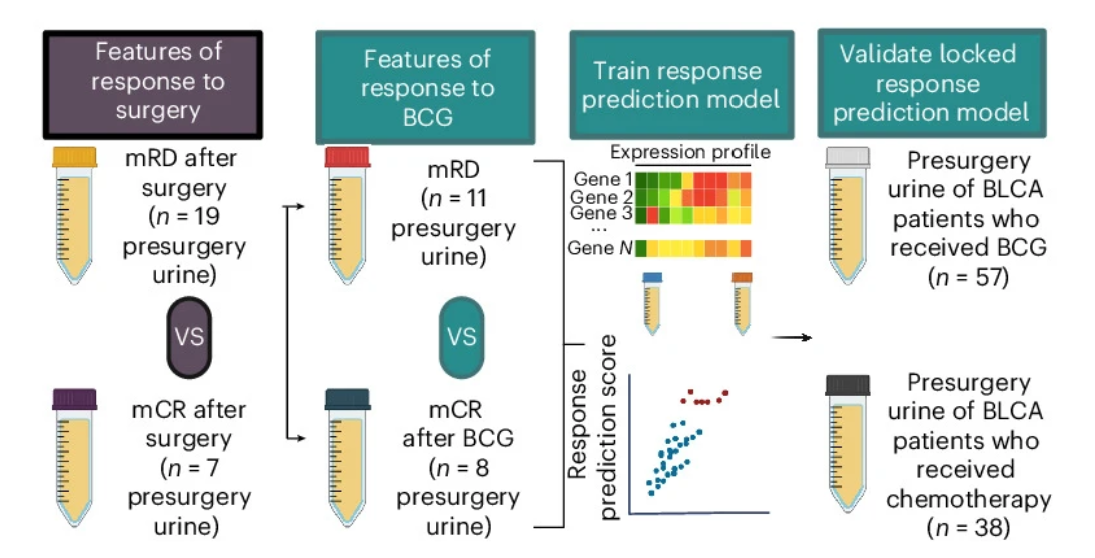
Schematic for training and validating the intravesical therapy response prediction model
Earlier Diagnosis and Smarter Triage
A urine cfRNA test with about 95% sensitivity at 90% specificity could help in several settings, though not necessarily as a stand-alone replacement for cystoscopy:
- Triage for hematuria. Patients with blood in the urine are often sent for cystoscopy. A highly sensitive urine test could help prioritize who needs it urgently.
- Detection of low-grade tumors that cytology routinely misses.
- Screening of high-risk groups. Older smokers and people with occupational exposures could someday be screened without an invasive procedure. The paper says only that screening is a potential application. It has not been tested.
Guiding treatment decisions
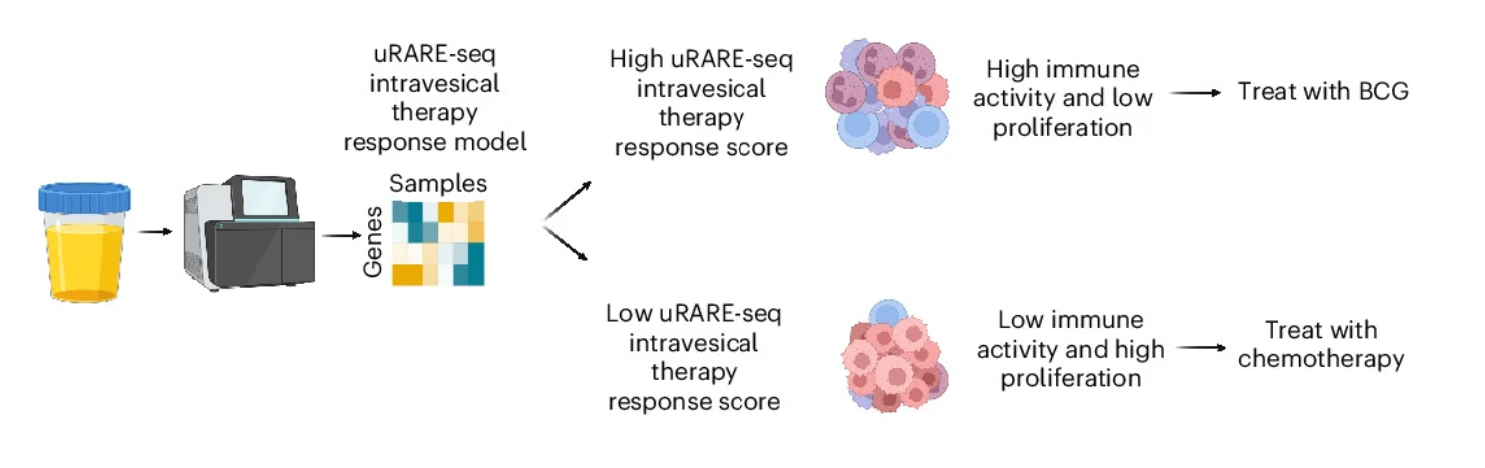
Schematic of potential application of uRARE-seq for personalizing choice of intravesical adjuvant therapy in NMIBC
The therapy response model hints at a precision-medicine workflow:
- High immune activity, low proliferation: treat with BCG.
- Low immune activity, high proliferation: consider chemotherapy.
The grade model could flag "low-grade" tumors that behave aggressively, so these patients might receive more intensive follow-up. The invasion model could flag NMIBC patients who may be understaged and have unrecognized muscle-invasive disease.
Monitoring and recurrence detection
The MRD results suggest a cfRNA test could tell clinicians whether treatment worked. A negative post-BCG test identified patients at very low risk of recurrence. A positive test flagged those at high risk. Such information could eventually allow:
- De-escalation of surveillance for patients with a molecular complete response, sparing repeat cystoscopies.
- Early intervention for patients with persistent disease, before a visible recurrence.
These uses need prospective testing before changing practice.
Personalised Medicine
Because uRARE-seq is tumor-naive, it needs no sequencing of the patient's tumor, so it can be run from a single sample. The authors also envision applications to kidney and prostate cancer and to benign genitourinary conditions, since the same urine signal carries information about those organs.
CHALLENGES AND FUTURE DIRECTIONS
Limitations the authors acknowledge
The authors are open about the study's limits:
- Case–control design. Patients with known cancer and controls are an easier test than a real screening population.
- Two affiliated, geographically adjacent institutions (Stanford and the VA Palo Alto). Validation samples came from the same sites, though they were independent of training.
- Modest sample sizes in some analyses. The response model was trained on just 19 patients. The chemotherapy validation cohort had only 5 recurrences among 38 patients, so those results, though striking, are preliminary. The AUC of 0.93 comes from cross-validation in a small cohort.
- Non-randomized treatment cohorts. Treatment assignment may have been influenced by confounders the study did not measure.
- Control groups. Specificity stayed high in benign urologic conditions, but the number of patients per diagnosis was small, and not every confounding condition was explored.
- Muscle-invasion model. Validation AUC was 0.75, which is only moderate.
A further point for readers: several authors report ownership interests in Resero Bio and patent filings related to urine cfRNA. This is disclosed in the paper and doesn't invalidate the findings, but it is context to keep in mind until independent groups replicate them.
Hurdles to Clinical Use
- Prospective validation. The key test is a prospective study in the intended-use population, for example patients with hematuria before cystoscopy, with predefined thresholds.
- Specificity. At 90% specificity, about one in ten people without cancer would test positive. In a screening setting that means many follow-up procedures. The study's MRD analyses used stricter thresholds (95–99% specificity) to deal with this.
- Standardization. Collection, processing, extraction and sequencing workflows must be reproducible across labs. The stability results (up to 48 hours, one freeze–thaw cycle) are encouraging, but multi-site ring trials are needed.
- Cost and turnaround. Targeted sequencing with 50–60 million read pairs per sample must become affordable and fast enough for routine use.
- Regulatory and reimbursement pathways, and proof that results change outcomes, not just predict them.
- Comparison with other approaches. The authors say future work should compare uRARE-seq against ultrasensitive tumor-informed cell-free DNA assays.
REFERENCES
Liu KJ, Shi WY, Nesselbush MC, et al. Urine cell-free RNA for bladder cancer detection and treatment response prediction. Nat Med. 2026. doi:10.1038/s41591-026-04673-3
0 comments